
For most of the last decade, offensive security ran on a calendar. You booked a pentest, a team poked at your systems for two weeks, you got a PDF, and you fixed what you could before the next cycle. That rhythm made sense when infrastructure changed slowly. It doesn’t hold up anymore.
Cloud resources spin up and die in minutes. Identity, not the network perimeter, decides who can reach what. And attackers have started pointing AI agents at the same targets, running reconnaissance and chaining bugs at a speed no human team matches. A growing crop of platforms answers that shift by putting autonomous agents on the defensive side. Here are six worth knowing in 2026, what each one actually does well, and where it fits.
What counts as an AI offensive security platform
The label gets slapped on everything these days, so it helps to draw a line. A vulnerability scanner finds known issues and hands you a list. An AI offensive security platform tries to use those issues the way an attacker would, chaining them into a path that ends somewhere it shouldn’t.
The good ones share a few traits. They reason about a target instead of running fixed checks. They adapt when a route fails. And most run continuously rather than once a quarter, re-testing as the environment shifts. Some go after infrastructure and identity. Others go after the AI models themselves. The six below split roughly along that line, which is the first thing to sort out before you shortlist any of them.
The six platforms
I’ve grouped these by what they target rather than ranking them head to head, because a tool built to break LLMs and a tool built to map your external attack surface aren’t really competing for the same job.
1. Novee
Novee is one of the newer names here, and it takes the purest black-box approach of the group. You point it at a domain and it starts reasoning about the environment from zero knowledge, the same way an external attacker would. No agents to deploy, no source code, no sensors sitting inside your network.
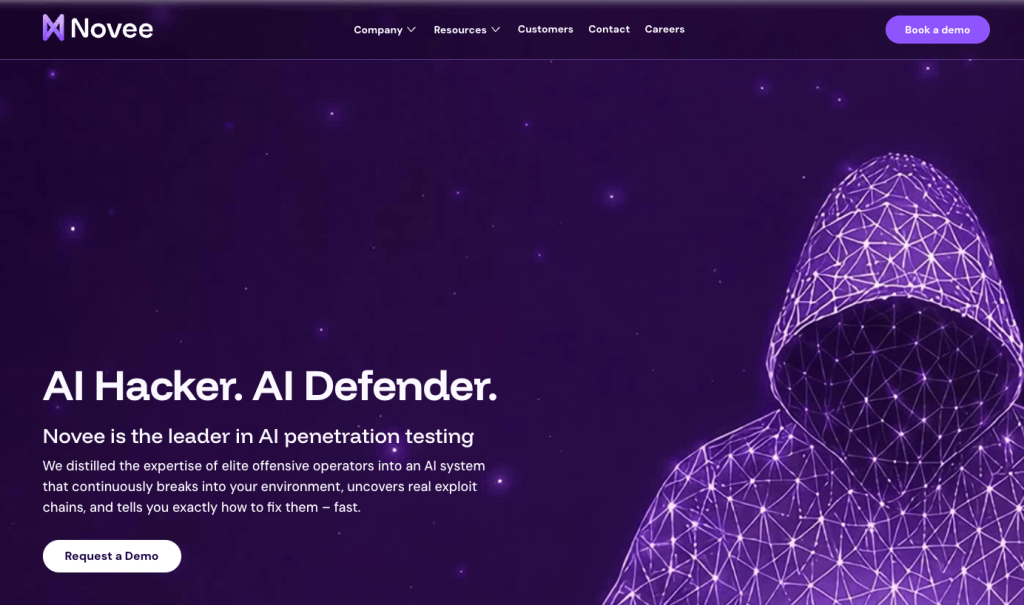
What I find useful about its model is the validation step. Plenty of tools flag a theoretical issue and move on. Novee tries to confirm exploitability, hands back reproduction steps, then automatically retests once you’ve pushed a fix to check whether the hole is actually closed or just narrowed. That closes the loop that usually eats the most time in a remediation cycle.
It leans toward identity-centric environments, where access relationships define the attack surface more than network segmentation does. If most of your risk lives in roles and integrations rather than open ports, that focus lines up well. For teams that want continuous validation without a heavy onboarding lift, the domain-only setup is the selling point.
2. RunSybil
RunSybil comes with a pedigree that’s hard to ignore. It was founded by Ari Herbert-Voss, OpenAI’s first security research hire, and Vlad Ionescu, who ran Red Team X at Meta. In March 2026 the company raised a $40M Series C led by Khosla Ventures, with Anthropic’s Anthology Fund and Menlo Ventures among the backers. That kind of money tends to follow real traction.
Its agent, Sybil, does black-box testing by interacting with running systems rather than reading code. It probes authentication boundaries and chains weaknesses across code, APIs, cloud, and infrastructure, focusing on the seams where components connect. That’s usually where the interesting compromises hide.
The reporting angle is what stands out to me. Instead of dumping a thousand findings, Sybil builds attack narratives that show how a low-privilege foothold turns into something worse. For an enterprise running zero-trust, that’s a direct way to check whether your segmentation actually holds up under pressure, not just on the architecture diagram.
3. Hadrian
Hadrian looks at you from the outside in. The Amsterdam company, founded in 2021, built its platform around the attacker’s first move, mapping everything reachable from the public internet and then testing whether any of it can be exploited.
That external-first angle makes it a fit for large organizations with sprawling public infrastructure and assets nobody remembers spinning up. Its agents probe continuously and try to rank what they find by real exploitability, so you’re not drowning in a flat list of exposures with no sense of which ones matter.
The company says its approach cuts remediation time by around 80% and that its agents can scan billions of assets a day. Treat those as vendor figures rather than independent benchmarks. Even discounted, the core idea holds up. If your biggest blind spot is the internet-facing stuff you’ve lost track of, Hadrian is built for exactly that problem.
4. Mindgard
Mindgard plays a different game. It isn’t trying to break your network. It’s trying to break your models. The company spun out of Lancaster University in 2022, led by Dr. Peter Garraghan, and built what it calls DAST for AI, dynamic security testing aimed squarely at LLMs and machine learning systems in production.
The threats it simulates are the ones that don’t show up in a normal pentest. Prompt injection. Data leakage through model outputs. Manipulation designed to slip past guardrails or skew a model’s decisions. In early 2026 it added a reconnaissance module that maps a model’s guardrails and the external tools wired into an AI app, basically profiling the attack surface before going after it.
If you’ve got AI sitting in customer support or wired into an agent that can touch real systems, this is the category you can’t cover with infrastructure tools. Mindgard is one of the more established names doing it, with roughly $11.6M raised and a research lineage that predates the current AI hype cycle.
5. HiddenLayer
HiddenLayer overlaps with Mindgard on AI security but comes at it from the runtime side. The Austin company, also founded in 2022, focuses less on pre-deployment testing and more on how models behave once they’re live and getting hit with hostile input.
It simulates model extraction and evasion attacks, plus the poisoned inputs meant to quietly steer a model’s behavior over time. It also scans model files themselves for supply-chain risks like malicious deserialization, a threat most AppSec teams haven’t started thinking about yet.
HiddenLayer is the better funded of the AI-security pair, having pulled in around $56M with backers like M12 and IBM Ventures. The practical draw is visibility. You get to watch how your models react under attack and whether your existing controls notice anything at all. For a security team that’s just inherited a fleet of deployed models, that baseline is worth a lot.
6. Cobalt
Cobalt is the outlier, and on purpose. Rather than going fully autonomous, it pairs AI-assisted workflows with a vetted community of more than 400 human pentesters. The company has been around since 2013 and more or less invented pentest-as-a-service, so it’s the veteran of the list.
Here’s the logic. AI handles the parts machines are good at, like reconnaissance and remediation tracking, while human testers take the work that still needs judgment. Business logic abuse and the creative, multi-step flows a model tends to miss. In March 2026 Cobalt rolled out new AI features for continuous pentesting, and its own research claims PtaaS surfaces complex bugs at four times the rate of bug bounties. Vendor data again, but a reasonable directional signal.
If you want the persistence of automation but don’t trust a machine to sign off on your security posture alone, the hybrid model is a sensible middle ground. It’s also the easiest sell to an auditor who still expects a human name on the report.
Autonomous agents changed the math
The reason this whole category exists comes down to one shift. Old-school automation follows a script. It runs its checks, and when the script hits a wall, it stops. An agent doesn’t stop. It has a goal, and it keeps looking for another way in.
Block its API access and it goes hunting for an identity it can borrow. Privilege escalation fails on one box, it pivots to the one next door. Run into segmentation and it starts testing the paths around it. That persistence is what makes a human red teamer dangerous, and it’s now something software can approximate around the clock.
The uncomfortable part is that attackers get the same upgrade. Once adversaries are running autonomous agents against you, periodic testing on the defensive side stops being enough. Matching that tempo is the real argument for these platforms, stripped of the marketing.
How to pick one for your stack
Start with what you’re actually trying to protect, because these tools don’t all do the same job. That split is the first filter.
- Infrastructure and identity. Novee, RunSybil, and Hadrian go after networks, cloud, access relationships, and external exposure. RunSybil and Novee work inside-out and outside-in respectively, while Hadrian is your pick if forgotten internet-facing assets are the worry.
- AI and models. Mindgard and HiddenLayer cover what the others can’t touch. Mindgard leans toward testing before and during deployment, HiddenLayer toward runtime behavior and model-file risks.
- A human safety net. Cobalt, if you want autonomous coverage backed by people who can reason about context an agent misses.
After that, look at how the tool proves a finding is real. The platforms that validate exploitability and retest after a fix save your team far more time than the ones that just raise alerts. And check how it slots into your existing workflow. A platform that dumps findings into a tool nobody opens isn’t continuous in any way that counts.
None of these replaces a smart human who knows your business. What they change is the cadence. Instead of finding out twice a year whether your defenses hold, you find out continuously, against an attacker that doesn’t clock out. Pick the one that matches where your real risk sits, make it prove its findings, and treat the vendor benchmarks with the skepticism they deserve.