
Compliance used to be an annual checkbox exercise. That’s not the world anymore. Regulations shift quarterly, customers demand proof on demand, and according to ISACA’s research, regulatory compliance is the top focus area for the majority of digital trust professionals heading into 2026. An IDC study found that teams using automated compliance platforms spend 82% less time on audit prep than those running manual processes. The gap between “we have a spreadsheet” and “we have a platform” keeps widening.
We evaluated four platforms that show up repeatedly on GRC and security team shortlists. Rather than building a made-up scoring rubric, we focused on what actually separates these tools in practice – how much manual work disappears, how well evidence maps across overlapping standards, whether the integrations go deep enough to replace your CSV exports, and how the platform holds up once you bolt on a fourth or fifth framework.
Not all of these platforms are trying to do the same thing. That’s the most important thing to understand before comparing them.
What these platforms actually do (and where teams get stuck)
A compliance management platform connects to your existing infrastructure – cloud accounts, code repos, HR systems, identity providers – pulls evidence automatically, maps it to whatever frameworks you’re running, and gives you a live view of audit readiness instead of a last-minute scramble.
The core jobs are evidence collection, control mapping across frameworks, gap detection, and workflow routing so the right person fixes the right thing. None of that is controversial.
Where teams get stuck is the overlap. Most mid-market companies don’t run one framework. They run SOC 2 and ISO 27001, or SOC 2 and HIPAA, or all three plus whatever a new enterprise customer just demanded. The platforms that actually reduce workload are the ones that let you collect evidence once and reuse it across multiple standards. The ones that don’t handle cross-mapping well just move the spreadsheet problem into a fancier interface.
The other trap is confusing integration count with integration depth. A platform can list 200 connectors, but if the ones you actually need – your cloud provider, your CI/CD pipeline, your identity provider – are shallow or unreliable, you’re still exporting CSVs by hand. Depth beats breadth every time.
Vanta – automation-first, and it shows
Vanta is a trust management platform built around streamlined automated compliance, and the automation piece isn’t just positioning. The platform runs 1,400+ pre-built automated tests on an hourly cycle across 400+ native integrations. That volume matters because most of your evidence collection happens in the background without someone remembering to take a screenshot every quarter.
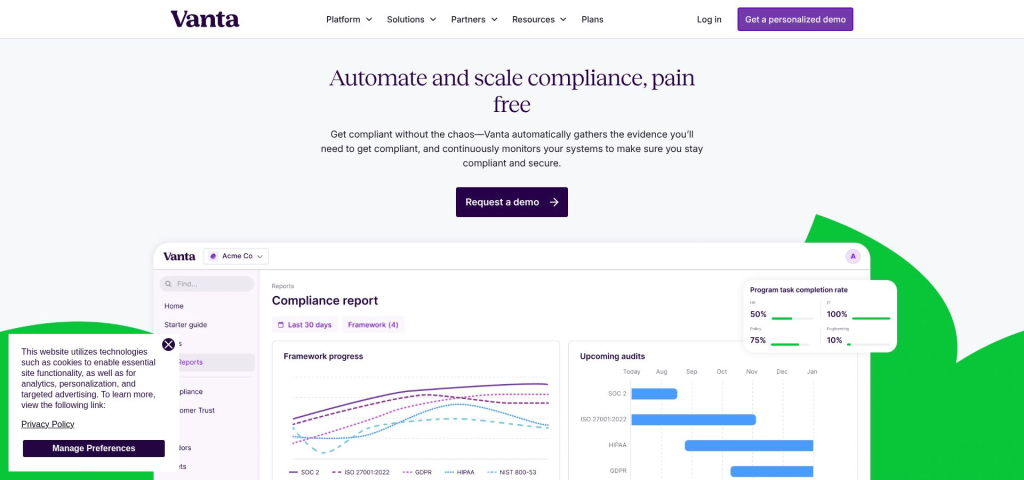
Founded in 2018, Vanta now reports 14,000+ customers and earned a Leader spot in the 2025 IDC MarketScape for worldwide GRC software. It supports 35+ pre-built frameworks along with custom framework support, and cross-maps controls and evidence across all active frameworks. Adding a new standard later typically builds on what you’re already collecting rather than forcing you to start from zero.
What the 400+ integrations actually get you
The headline number is fine, but the more practical differentiator is integration-level scoping. You can include or exclude specific resources – non-production cloud accounts, test repos, sandbox environments – without reconfiguring every individual test. For teams with messy multi-account AWS setups or a mix of production and staging, that granularity saves real time during onboarding and keeps your compliance posture from drowning in irrelevant alerts.
Vanta’s AI Agent shows up across several workflows. It handles remediation guidance and policy generation through what they call the Smart Policy Builder, plus security questionnaire completion. The vendor risk management module handles third-party assessments, and the auditor portal cuts back-and-forth during engagements. There’s also a built-in Trust Center with CRM integrations and an AI chatbot for prospects, which turns compliance status into something your sales team can actually point people to.
For larger organizations running multiple entities, Vanta supports Workspaces that let you manage frameworks by business unit, subsidiary, or product line.
Where it gets noisy
The onboarding period is real. Most new teams spend about a week pruning alerts and tightening scope before the platform reflects their actual environment instead of firing off noise. Skip that tuning phase and the dashboard becomes overwhelming fast.
Pricing runs on tiered packages based on employee count and the frameworks or modules you need. Support is 24/5 with published metrics.
The bigger trade-off is flexibility. Vanta is opinionated about how compliance should work, and that opinion is “automate everything possible.” For most teams, that’s a feature. If your team wants a heavily customizable GRC workflow builder where every process is designed from scratch, this isn’t that. But for fast-growing SaaS and mid-market to enterprise teams juggling multiple frameworks, the automation depth and evidence reuse across standards are hard to beat. The Trust Center adds real sales-cycle value if compliance proof is part of how you close deals.
Hyperproof – the audit project manager
Hyperproof sits in an interesting middle ground between lightweight automation tools and legacy enterprise GRC suites. What it actually does well is audit project management. Kanban-style boards and task views with owner accountability tracking make it easy to see what’s blocking readiness across many stakeholders.
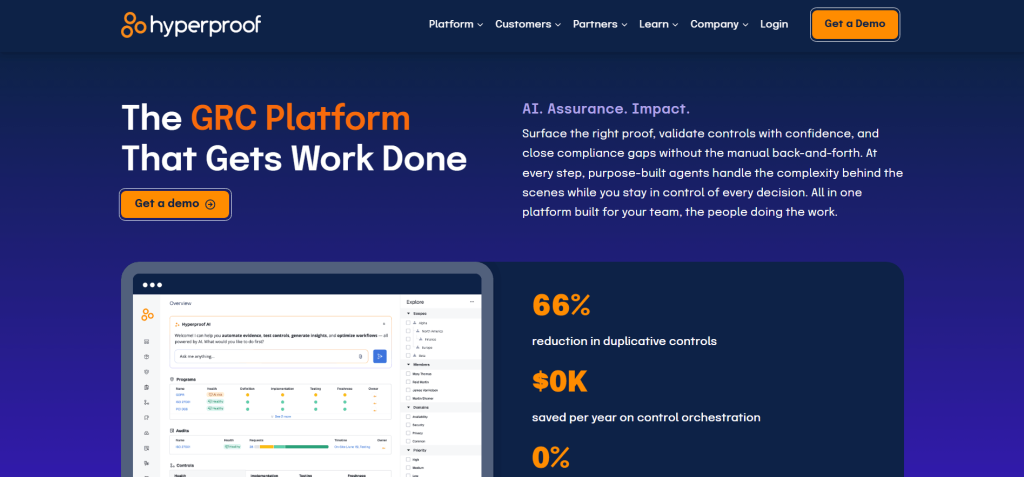
Founded in 2018 and based in Seattle, Hyperproof supports the frameworks most mid-market teams care about – SOC 2, ISO 27001, HIPAA, PCI DSS, NIST, GDPR – plus templates for programs like CMMC and FedRAMP. It has 70+ integrations with continuous collection for connected systems.
The trade-offs are real, though. Integration depth runs shallower than automation-first competitors, with fewer pre-built technical checks. Many teams still plan for manual follow-up on edge-case controls. Cross-framework mapping exists but can get labor-intensive. In buyer calls, customers have described the cross-walking process as frustrating, involving a lot of manual mapping and linking that gets messy without careful upfront scoping.
Hyperproof’s AI assistant handles control language suggestions and evidence gap detection, but customer feedback consistently puts it behind newer platforms on AI maturity. The risk register works, but integration with tools like Jira and Linear can feel disconnected – another system to update rather than meeting teams where they already work.
There’s no dedicated, prospect-facing Trust Center. Evidence sharing is audit-oriented rather than self-serve.
Pricing comes in three tiers (Professional, Business, Enterprise), quote-based, with unlimited users and pre-built framework templates included. If you define your control taxonomy and ownership model early, rollout goes smoother. Skip that step and you’ll spend time reorganizing later.
Best for – Mid-market security and GRC teams that value strong task visibility and audit workflow management, and will invest the upfront taxonomy work to keep multi-framework reporting clean.
OneTrust – a governance empire with compliance bolted on
Here’s what most people miss about OneTrust. It’s a governance platform, not a compliance automation tool. Privacy management, ethics, AI governance, third-party risk, consent workflows. Security compliance is one module in a much larger ecosystem, and not the one most customers buy it for.
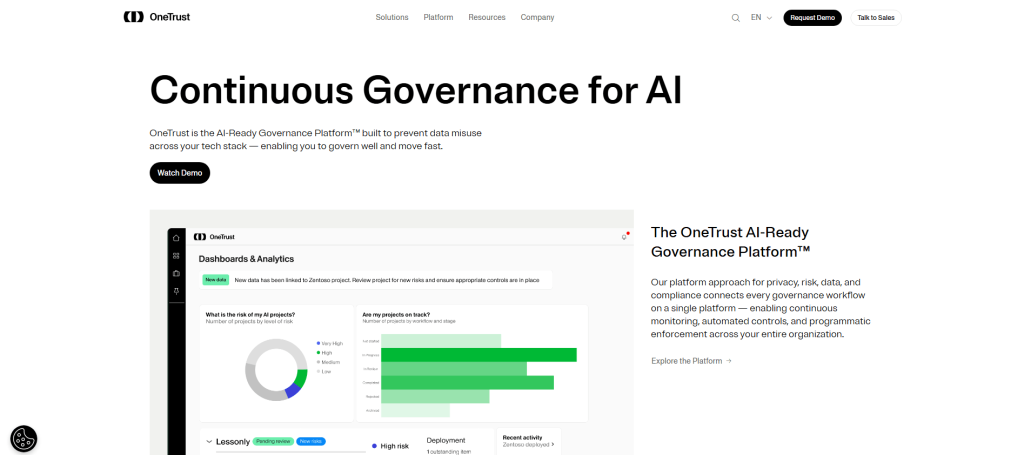
Founded in 2016 with dual headquarters in Atlanta and London, OneTrust has roughly 3,500 employees and has raised $1.13B. The company reported about $500M in ARR as of May 2024. They claim 14,000+ customers and say 75% of the Fortune 100 use their platform. The catch is that approximately half those customers primarily use OneTrust for cookie consent. When you’re evaluating it specifically as a compliance automation tool, that distinction matters.
OneTrust added SOC 2 and ISO automation through its 2021 Tugboat Logic acquisition. The Tugboat product was rebuilt rather than ported, and the compliance automation side is generally less automation-first than platforms designed from the ground up around technical evidence collection. Expect more manual evidence work for many controls.
Where OneTrust genuinely stands out is AI governance. Its responsible AI offerings are a real differentiator for organizations tracking requirements like the EU AI Act. On the day-to-day compliance side, AI is less embedded into remediation and evidence workflows. Coverage spans security standards and a wide set of privacy laws, with the ability to map privacy obligations back to security controls. Reporting leans on Power BI, which is powerful if you have someone who knows it, but requires configuration. Vendor risk management is a core module with questionnaire workflows built in.
The implementation reality is enterprise-grade complexity. Multi-month timelines, often requiring consulting support. Pricing is module-based with Tech Risk and Compliance, Privacy, AI Governance, and VRM sold separately.
Best for – Large global organizations that need a consolidated privacy and governance hub, especially if they already run OneTrust for consent or privacy workflows. If your primary goal is automating SOC 2 and ISO evidence collection without the governance layer, this is probably more platform than you need.
Optro – built for SOX, stretched into compliance
Optro started in 2015 as a SOX management tool, and that DNA still shows. If your organization runs formal internal audits – especially SOX and IT general controls – the workflow is its clear strength. Planning engagements, requesting evidence, testing controls, and issuing findings all happen in one system.
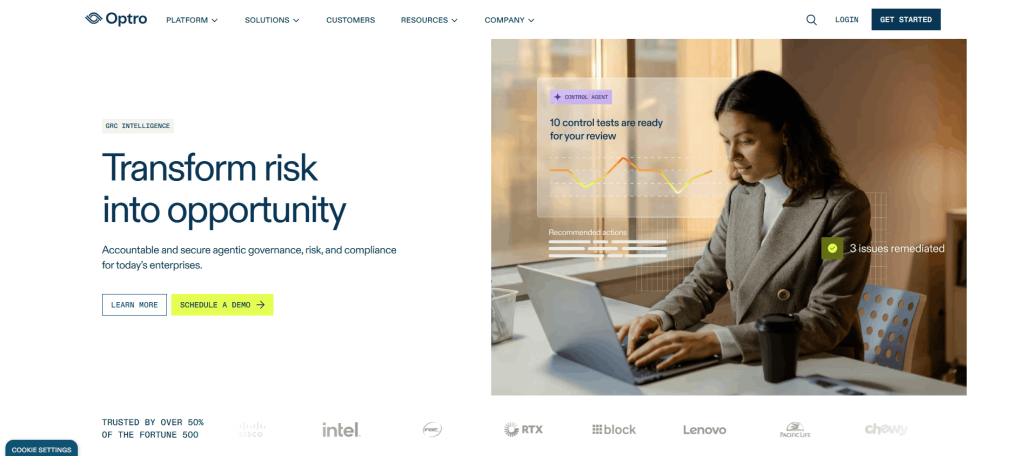
Cybersecurity compliance modules came in the early 2020s, and the gap shows most in automation depth. Optro has significantly fewer integrations than automation-first tools, with only about 10 pre-built monitors out of the box. Those checks tend to be high-level (“is encryption enabled?”), and extending coverage means building custom tests manually. Each one takes 5 to 30 minutes to set up, which adds up fast in environments with any real complexity.
Cross-framework mapping is technically possible but becomes more of an administrative linking exercise than automated evidence reuse. Optro has been adding AI features and acquired Risky for continuous third-party risk monitoring, though integration is still evolving. No dedicated Trust Center for prospect-facing sharing.
Day-to-day usability is where it draws the most criticism. Buyer feedback describes the tool as inflexible and expensive to customize. G2 reviewers frequently flag workarounds and dashboard limitations alongside a steep learning curve. Pricing is enterprise-level and modular, with implementations that often need significant professional services. The recurring theme in feedback is that enhancements feel like paid consultative projects rather than something you can configure yourself.
Best for – Large enterprises with mature internal audit functions that need strong SOX workflow management. Most teams end up pairing Optro with separate tools for continuous technical monitoring, effectively using it as a system of record for audit tracking rather than the engine driving compliance automation.
Picking the right one
No platform guarantees you’ll pass an audit. Auditors assess your actual practices and whether your program operates effectively. What automation buys you is fewer last-minute surprises and a cleaner evidence trail.
Start with your framework list. Write down everything you must meet today, then add whatever’s likely landing on the roadmap next year. A tool that handles SOC 2 but falls short on PCI or NIS2 becomes a blocker the moment a customer asks for the next attestation.
Then pressure-test integrations against your actual stack, not the vendor’s integration page. If most of your evidence lives in AWS and GitHub, or behind Okta, you want deep, reliable connectors for those systems. A high number on a marketing slide means nothing if the connectors you need are shallow.
Factor in total cost, not just licensing. Implementation time and ongoing admin effort add up, especially if your team is distributed and evidence lives across different environments. A cheaper tool that pushes work back onto engineers can erase any licensing savings in a quarter.
Run a pilot before committing. Two weeks connecting your core systems and producing a real gap view tells you more than any demo call ever will. If the platform surfaces actual issues quickly and your team is willing to open it every week, you’ve got your answer.