

Residential proxy networks have become essential tools for businesses and individuals who need to mask their online identity while appearing as ordinary internet users. These services route traffic through real residential IP addresses assigned by Internet Service Providers (ISPs) to actual households, making web requests virtually indistinguishable from regular consumer browsing. This guide explores how these networks function, their strengths and limitations compared to other proxy types, practical applications, legal considerations, leading providers, and key performance metrics.
How Residential Proxy Networks Operate
Architecture and Request Routing
When traffic passes through a residential proxy, the request gets intercepted and forwarded through an intermediary server. This server then sends the request to the target website using a residential IP from the provider’s pool. The target site sees the request originating from a genuine home network IP rather than the user’s actual device. The response travels back through the same proxy path, effectively hiding the real IP address.
IP Sourcing Methods
Residential proxy networks obtain their IP addresses through several methods. Many operate as peer-to-peer (P2P) networks where users opt in by installing software or SDKs that share their bandwidth in exchange for free services or compensation. Other providers partner directly with ISPs to lease IP ranges for proxy use, commonly for static residential proxies.
Ethically operated networks ensure that IPs come from consenting users. Some providers have obtained independent certifications verifying 100% opt-in IP sourcing, which distinguishes them from questionable services that may use malware or unwitting participants.
IP Rotation Mechanics
A defining feature of residential proxy networks is the ability to rotate IP addresses frequently. Providers maintain large pools of residential IPs, often numbering in the millions globally. Users typically connect via a gateway node that automatically cycles through different residential endpoints.
Most services offer configurable rotation settings. Rotating mode assigns a new IP for each request, while sticky sessions maintain the same IP for a set duration before switching. This flexibility allows users to emulate normal browsing behavior since requests originate from many different residential IPs.
Anonymity and Fingerprint Masking
Because traffic exits through real residential devices, it inherits genuine network characteristics of consumer ISPs. The ISP ASN, geolocation, and network latency patterns all match normal residential traffic. Research indicates that approximately 84% of websites fail to detect bot or automated activity when residential proxies are used, a significantly higher evasion rate than datacenter alternatives.
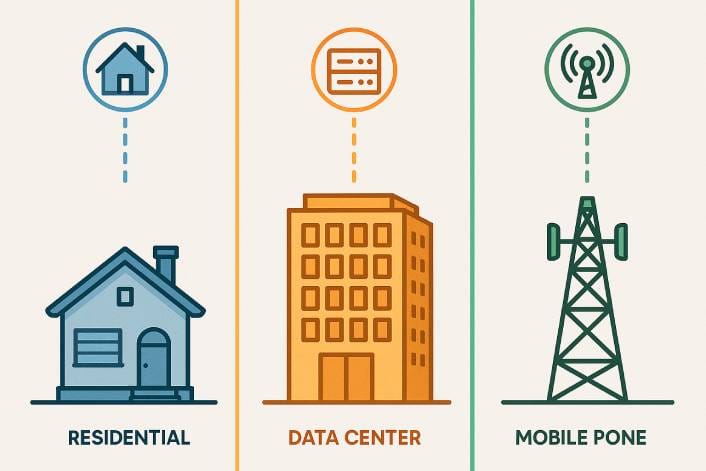
Comparing Proxy Types: Residential vs. Datacenter vs. Mobile
Quick Comparison Table
| Criteria | Residential Proxies | Datacenter Proxies | Mobile Proxies |
|---|---|---|---|
| IP Source | Real ISP-assigned home addresses | Data center servers | 3G/4G/5G cellular networks |
| Detection Risk | Very low | High | Extremely low |
| Speed | Moderate | Fast | Moderate to slow |
| Cost | High (per GB) | Low | Very high |
| Best For | Protected site scraping, ad verification | Bulk scraping, high-speed tasks | Social media, mobile app testing |
Advantages of Residential Proxies
High Anonymity and Low Block Rates: Residential proxies appear as ordinary users and evade detection by most anti-bot systems. They face far lower flagging or blacklisting compared to datacenter proxies, which often come from known cloud provider IP ranges.
Geographic Flexibility: Residential proxy networks maintain IPs across thousands of cities and ISPs worldwide. This granular geo-targeting proves invaluable for testing localized content, accessing region-locked data, or verifying ads across different locations.
Bypassing Restrictions: Many websites aggressively block datacenter IP ranges or impose CAPTCHAs on suspicious traffic. Residential proxies achieve over 95% success rates on well-protected sites like Amazon or Google, where standard datacenter proxies would face immediate bans.
Reliability for Extended Sessions: Residential IPs maintain lower ban rates over long sessions, making them suitable for account-based activities like managing multiple social media profiles or monitoring e-commerce listings.
Disadvantages of Residential Proxies
Higher Cost: Residential proxies cost significantly more than datacenter alternatives. Pricing typically runs per gigabyte of bandwidth, ranging from approximately $2-15 per GB, while datacenter proxies can cost mere cents per IP.
Slower Performance: Routing traffic through consumer connections means slower and less consistent speeds than datacenter backbones. Response times often reach hundreds of milliseconds, whereas datacenter proxies can achieve tens of milliseconds.
Availability Fluctuations: Certain high-demand geolocations may have limited IP supply at any given moment. Since IPs come from real devices that may go offline, providers cannot guarantee the same IP is always available.
Common Use Cases
Web Scraping and Data Extraction
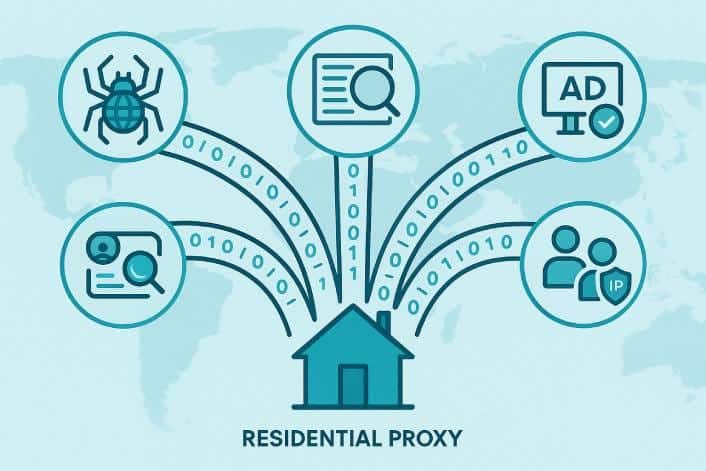
Large-scale web scraping represents the primary use case for residential proxies. By cycling through real IPs, scrapers can crawl e-commerce sites, travel aggregators, and social media platforms without getting blocked. Businesses use these proxies to monitor competitor pricing, aggregate travel fare data, and collect product reviews.
SEO Monitoring and SERP Tracking
Companies and SEO professionals use residential proxies to track search engine results from various locations. Search engines display different results based on user location, making residential IPs essential for accurate keyword ranking checks and SEO audits across regions.
Market Research and Price Monitoring
Firms employ residential proxies for competitive intelligence, including price monitoring, travel fare aggregation, and competitor analysis. Using residential IPs allows continuous monitoring without detection or being served misleading information.
Ad Verification and Brand Protection
Advertising networks and brands use residential proxies to verify that ads appear correctly across different geographies. By connecting through various city-based IPs, auditors can confirm ad campaign delivery and detect potential ad fraud or malicious placements.
Social Media Management
Running multiple accounts on platforms like Facebook, Twitter, or Instagram often requires residential proxies. These platforms monitor IP usage closely, and logging into many accounts from the same IP triggers red flags. Residential proxies allow account managers to assign each account a distinct IP identity.
Performance Metrics
Success Rate
Residential proxies excel at completing requests without blocks. Industry research shows median success rates above 99% for residential proxy infrastructure, with top providers reaching 99.95% in global tests. This compares favorably to datacenter proxies, which often face 50% or higher block rates on strict targets.
Response Time and Bandwidth
Typical response times for residential proxy requests range from approximately 0.5 to 1.5 seconds, depending on target site speed and proxy location. The fastest providers achieve 0.3-0.5 second average response times. While slower than direct datacenter connections, this overhead remains acceptable for most use cases.
IP Rotation Effectiveness
Effective rotation requires more than a large pool. Provider systems must manage IP allocation to prevent accidental reuse during concurrent requests and cool off recently blocked IPs. Top providers with pools exceeding 100 million addresses minimize repetition even during intensive scraping operations.
Concurrent Connections
High-quality residential proxy services allow hundreds or thousands of simultaneous connections without performance degradation. Many advertise unlimited threads, with the bottleneck typically being user-side or target-site limitations rather than proxy infrastructure.
Providers and Pricing
The residential proxy market has grown highly competitive, with prices dropping up to 70% compared to two years ago. Here are some major providers:
| Provider | IP Pool | Starting Price | Key Features |
|---|---|---|---|
| Decodo | ~115 million | $1.50/GB | Unlimited concurrent connections |
| Bright Data | ~72 million | ~$5.88/GB | Extensive targeting, browser extensions |
| Oxylabs | ~100 million | $8/GB | 99.95% success rate, ~0.6s response |
| SOAX | ~155 million | $2.30/GB | Fine-grained city and ASN targeting |
| NetNut | ~85 million | $5/GB | ISP partnerships for faster connectivity |
| IPRoyal | ~32 million | $1.75/GB | Budget-friendly, opt-in network |
| PacketStream | Low millions | $1.00/GB | Community-driven P2P marketplace |
When selecting a provider, consider IP pool size and diversity, geo-targeting options, rotation control, success rates, and overall cost. Most providers offer free trials or money-back periods for testing specific workloads.
Legal and Ethical Considerations
Legality of Residential Proxies
Using a residential proxy service is legal in most jurisdictions. A proxy simply routes internet traffic via an alternate path. However, illicit activities carried out via proxies remain illegal. The Computer Fraud and Abuse Act (CFAA) and similar laws can penalize unauthorized access or system abuse, regardless of proxy use.
Web scraping may breach website Terms of Service, potentially leading to lawsuits. Copyright violations through proxies remain illegal. The proxy itself is not illegal, but what users do with it may be.
Ethical Sourcing
A critical ethical question concerns how providers obtain their residential IPs. Ethical providers secure IPs through user consent via SDKs in apps or opt-in programs where users agree to share idle bandwidth. Some networks in the past have sourced IPs through malware or deceptive browser extensions, which poses legal risks for users of such services.
Best Practices
- Use only providers that clearly disclose their IP sourcing methods
- Understand the legal landscape before starting scraping projects
- Avoid overloading target websites, even when proxies prevent blocks
- Document data collection activities, especially involving personal data
- Integrate proxy usage into compliance and governance processes
Final Thoughts
Modern residential proxy networks deliver excellent reliability and effectiveness for tasks requiring high anonymity, geo-flexibility, or multiple identities. The gap between providers has narrowed as technology matures, with most offering similar core features like country and city targeting along with comparable success rates.
Differentiators now include speed optimizations, customer support quality, ethical sourcing practices, and value-added tools. For practical evaluation, piloting several providers through their free trials allows measurement of specific workload performance. The best choice balances stealth, speed, and support for the particular use case at hand.