
IP rotation refers to the practice of periodically changing the IP address used for internet connections. Rather than relying on a single static address, a rotating IP system assigns a new IP at set intervals or under specific conditions. This swap can happen automatically through a VPN service, proxy network, or ISP dynamic allocation.
By cycling through multiple IP addresses, this technique makes web activity appear to originate from different sources. The result is improved protection against tracking, IP-based blocks, and rate limits.
How IP Rotation Works
Several mechanisms enable IP rotation in practice:
- VPN-based rotation changes your public IP to that of the VPN server whenever you connect. Each reconnection or server switch produces a new IP. Some VPN providers rotate IP addresses automatically within the same server location, while others require manual server switching. VPN rotation also encrypts traffic, adding privacy beyond just changing the IP.
- Proxy-based rotation routes traffic through a pool of proxy servers, each with its own IP. The proxy service can assign a new address for each request or each session, depending on configuration. Web scraping tools commonly use rotating proxy services that fetch new IPs from large pools on demand. Approaches include request-based rotation (new IP per request) and timed rotation (switch IPs every X minutes). Different proxy protocols like HTTP and SOCKS handle this traffic in distinct ways.
- ISP dynamic IP rotation occurs with most home internet connections. Dynamic addresses may change periodically, often when rebooting the router or when the DHCP lease expires (commonly every 1-3 days). While this provides basic rotation, control over timing remains limited.
Automatic vs. Manual Rotation
Some systems rotate IPs automatically at fixed intervals or triggered events, while others require manual action. Many VPNs do not rotate your IP on their own during a session. You would need to disconnect and reconnect or change servers to get a new IP.
However, newer VPN features are emerging to automate this process. Surfshark offers a Rotating IP option that automatically changes your IP every five minutes without dropping the VPN connection. ExpressVPN takes a different approach with ShuffleIP, which assigns a new IP for every website or web server accessed, transparently and automatically.
Proxy services have long allowed automatic rotation. You can configure proxies to cycle IPs per request or on a timer, rather than manually fetching new proxies each time.
Rotation Frequency
The frequency of IP changes can often be customized or depends on the provider. High-volume web crawlers may rotate on every single request to avoid rate limiting, whereas a casual user’s VPN might rotate every few minutes or only when manually triggered.
Norton’s VPN lets users set IP rotation to as fast as every few seconds for maximum dynamics. Surfshark’s rotating IP switches on a 5-minute interval by default. ExpressVPN’s ShuffleIP effectively rotates continuously, with each new site receiving a new IP within the same location pool.
Security Implications and Considerations
Changing IP addresses can bolster privacy and security, but it also introduces certain side effects worth considering:
- Enhanced anonymity stands out as the primary benefit. Rotating IPs makes it much harder for trackers to profile your activity. Websites and advertisers often key off your IP, and if it constantly changes, they cannot easily link sessions into one identity. This also mitigates some cyber threats, since using a static IP for too long could expose you to DDoS attacks or hacking attempts.
- Session disruptions can occur with frequent IP changes. If you’re logged into a service and your IP jumps mid-session, some websites might log you out or require re-verification. Banking or email services may see a rapid IP switch as suspicious activity.
- CAPTCHAs and verification challenges become more common since websites may interpret rapid IP switching as bot-like behavior. You avoid outright blocks, but you might have to prove you’re human more often.
- Personalized content issues arise when services personalize content or language based on IP location. A rotating IP might confuse location-based services, resulting in inconsistent language settings, time zones, or content availability.
- Bad IP reputations can transfer when using shared IP pools. There’s a chance you receive an IP that has been abused by someone else before. If that IP is on a blacklist, you inherit that history until you switch again.
- Ethical and legal concerns deserve attention. IP rotation can be misused for scraping data or bypassing access controls in ways that might violate website Terms of Service. Providers caution users to stay within legal use, and using IP rotation for attacks or fraud is clearly illegal.
- Quality of service varies significantly between providers. Free or low-quality proxy services might route through compromised or extremely slow nodes. Reputable VPNs and proxy providers invest in large pools of clean IP addresses, whereas cheap services might recycle addresses already blocked on many sites.
Common Use Cases of IP Rotation
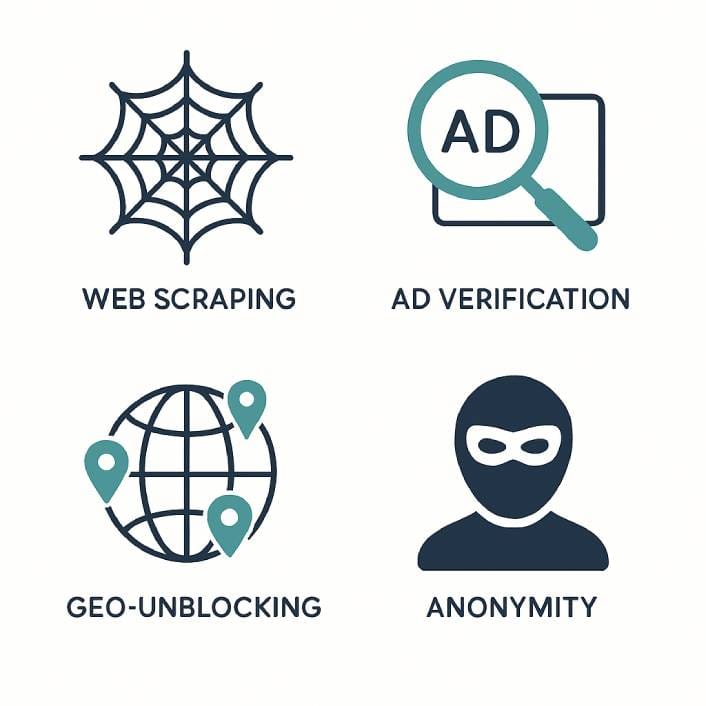
Rotating IP addresses serves critical purposes across several scenarios. Here are the most prevalent applications:
Web Scraping and Crawling
Perhaps the most prevalent use case, rotating IPs are essential for automated web data extraction. When a script scrapes a website extensively, using one IP will quickly get it flagged and blocked. By cycling through a pool of IP addresses, scrapers avoid per-IP rate limits and bans, making it appear as if requests come from many different users. This allows collection of thousands of pages of data without interruption.
Ad Verification
Companies often need to verify that online ads display correctly across different regions and contexts. IP rotation helps simulate real users from various geographic locations. By using residential or mobile IPs in different cities, an ad verification platform can check if an ad is running properly, ensure it’s not altered or defrauded, and see what local users see. Rotating through IPs prevents ad networks from recognizing the monitoring as coming from the same source.
Accessing Geo-Restricted Content
Many websites and streaming services restrict content based on location. IP rotation, especially via VPN, lets you swap your apparent location on the fly. By changing to IPs in different countries, you can access content unavailable in your region. A user could rotate to a UK IP for BBC iPlayer, then to a US IP for Netflix’s American library. This use case extends to getting around government censorship or local firewalls.
Maintaining Anonymity and Privacy
Even for regular browsing, IP rotation adds a layer of privacy. Each IP address can reveal information about you, including geo-location, ISP, and an identifier for tracking. Frequently changing your IP thwarts trackers and eavesdroppers who try to build a profile of your activity. This adds a crucial layer of online privacy. This benefits privacy-conscious individuals, journalists, activists, or anyone who wants to make it harder for websites and advertisers to trace their online behavior.
Avoiding IP Bans and Rate Limiting
Many services impose limits per IP. A news site might let you read 5 free articles per IP per day, or an API might rate-limit requests by IP. If you hit those limits or get banned due to someone else’s behavior, rotating to a new IP resets your access. This technique is fundamental for high-volume operations like load testing websites, where thousands of requests must be generated without all coming from one IP.
Additional use cases include SEO monitoring, where checking search rankings from multiple locales requires changing IP repeatedly to get unbiased results. Social media management can involve rotating IPs to handle multiple accounts safely. On the security front, rotating IPs can provide temporary protection against targeted attacks.
Comparison of IP Rotation Services
Various services and tools provide IP rotation capabilities. Below is an overview comparing leading VPN-based and proxy-based IP rotation services.
VPN Services: Surfshark vs. ExpressVPN
| Feature | Surfshark | ExpressVPN |
|---|---|---|
| IP Types & Network | Datacenter VPN IPs (shared). ~4,500+ servers in 100 countries | Datacenter VPN IPs (shared). ~3,000+ servers across 100+ countries |
| Rotation Mechanism | Rotating IP feature changes IP every 5 minutes within same location. Multi IP assigns unique IP per website/app | ShuffleIP assigns new IP for each website accessed, without changing VPN server |
| Pricing | Budget-friendly. ~$2/month on 2-year plans, ~$12.95 monthly | Premium pricing. ~$8-12 per month depending on plan length |
| API Support | No public developer API. Consumer-focused with apps | No public API. Consumer-focused with apps |
| Intended Users | Personal/Consumer. Ideal for privacy, streaming, and basic rotation needs | Personal/Consumer. Geared toward top-tier privacy, security, and streaming |
Both VPNs use shared IP pools, meaning multiple users share the same IP at a given time, which adds anonymity. Surfshark’s Nexus technology introduced user-controlled rotation features that can be toggled. ExpressVPN’s rotation is more transparent, happening continuously without user intervention on most servers.
ExpressVPN emphasizes a “different IP for every connection” approach, whereas Surfshark lets users choose between a static IP or rotating ones. ExpressVPN’s approach yields extremely frequent rotation, while Surfshark’s 5-minute interval is slower but still effective against tracking.
Proxy Rotation Services: Bright Data vs. Decodo vs. Oxylabs
| Feature | Bright Data | Decodo | Oxylabs |
|---|---|---|---|
| IP Types & Network | Residential, Datacenter, Mobile, ISP. ~72+ million residential IPs, 190+ countries | Residential and Datacenter. ~125+ million residential IPs globally | Residential, Datacenter, Mobile, ISP. Over 100 million IPs in 195 countries |
| Rotation Options | Per-request rotation or sticky sessions. Advanced tools like Web Unlocker and scraping APIs | Rotating proxies (new IP each request) and sticky sessions (up to 30 minutes). City-level geo-targeting | Per-request or sticky sessions. Next-Gen Residential Proxy with intelligent rotation and CAPTCHA handling |
| Pricing | Enterprise-level. ~$8-15 per GB for residential IP usage. Pay-as-you-go or subscription | Mid-range. ~$7.5 monthly for starter plans. ~$6.5/GB list price, lower on large plans | Enterprise pricing. Starting from $12 per GB for residential |
| API Support | Extensive API offerings, 120+ pre-built data collectors, SERP APIs | API endpoints for proxy management, scraping API as add-on | APIs and Web Scraper API for end-to-end data retrieval |
| Intended Users | Large businesses and enterprises. Professional web scraping, ad tech, market research | Small-to-mid size businesses and developers. Scrapers, marketers, hobbyists | Enterprises and large-scale users. High-volume data needs |
Bright Data and Oxylabs offer every type of IP, including mobile 4G proxies and ISP static residential proxies. Decodo focuses on residential and datacenter types with smaller-scale mobile options.
All proxy providers allow fine-grained rotation settings. You can configure proxies to request a new IP on each call or stick with one IP for up to 30 minutes if session consistency is needed. VPN services like Surfshark and ExpressVPN offer rotation largely as a blanket privacy feature rather than a programmable setting.
Pricing Models
Surfshark and ExpressVPN use flat-rate subscription services with unlimited usage including all IP rotations. Bright Data, Decodo, and Oxylabs use usage-based pricing with bandwidth or IP usage limits. Decodo provides a middle ground with much cheaper bandwidth costs for moderate needs.
Enterprises with mission-critical needs often choose Bright Data or Oxylabs despite higher costs, due to their reliability and extra features. Individuals who need to avoid IP blocks occasionally might prefer a VPN with rotation or a smaller proxy package from Decodo rather than investing in enterprise solutions.
Wrap Up
IP rotation is a powerful technique for privacy and access, using VPN servers, proxy networks, or dynamic IP pools to periodically change your online identity. It automates what would otherwise be manual IP changes, resulting in improved anonymity and the ability to dodge certain blocks or limits.
Consumer VPNs like Surfshark and ExpressVPN are incorporating IP rotation to enhance user privacy and access. They work well for everyday users who want simpler, one-click solutions. Bright Data, Decodo, and Oxylabs are purpose-built for high-scale IP rotation in professional contexts like scraping, offering massive IP pools and APIs for automation.
Choosing the right solution depends on the scale and nature of your needs. From personal privacy to enterprise data collection, there’s an IP rotation approach suited for each scenario.